From OneLake to the boardroom: Building a governed insights agent on Microsoft Fabric that produces executive-ready visuals
Every analytics leader has watched it happen.
The dashboard is perfect. The KPI is clear. And then someone in the room asks "why," and suddenly there are five competing explanations, three follow-up meetings, and an analyst scrambling to rebuild the same story for each stakeholder.
The most expensive thing in analytics isn't the dashboard. It's the second question.
This is the problem that governed insights agents solve: not "chat for data," but a system that turns governed enterprise data into a decision-grade artifact that stays coherent under executive scrutiny: visual, explainable, consistent, and ready for the boardroom.
Fabric is the platform. The ROI is decided in the Last Mile.
Microsoft Fabric is doing the hard, unglamorous work that makes modern analytics possible at scale. It collapses a fragmented stack into a unified foundation:
- OneLake as the shared data layer
- Data engineering and warehousing to shape analytics-ready assets
- Power BI semantic models as the business layer where definitions live
- Workspaces as the collaboration surface for publishing and governance
That's the first 99 miles, where most analytics programs invest heavily in pipelines, models, governance, and platform.
But ROI doesn't happen at mile 99. It happens at mile 100, when leaders can reliably move from "KPI moved" to "we agree on why" to "here's what we're doing about it."
In many organizations, the bottleneck has simply shifted downstream:
- Exploration is faster
- Access is better
- Dashboards are richer
And yet decision cycles still stretch because the story doesn't stabilize under follow-up scrutiny.
A governed insights agent is the missing last-mile layer that converts Fabric investment into decision velocity.
Why Zebra AI exists
Zebra BI has been the standard for decision-support visuals in Excel and Power BI for years. Over 3,000 companies, many of them Fortune 500, use our IBCS-style visual language to communicate variance, drivers, and performance in ways business stakeholders can instantly interpret.
That adoption happened for one reason: in finance and leadership settings, showing numbers isn't enough. You need to communicate the delta, what changed and why, with drivers, hierarchies, and implications that executives can read fast and challenge confidently.
Now, Zebra BI brings that discipline into the AI era. And to make it native to how teams already work, Zebra AI is available as a Workload on Microsoft Fabric, so analysis happens where your data and collaboration already live.
What a governed insights agent needs to do
In executive workflows, "governed" isn't a buzzword. It's what prevents AI analytics from collapsing into ambiguity.
A governed insights agent must produce outputs that are:
- Predictably structured: Answers follow a stable schema and reasoning pattern (even if wording varies), minimizing “answer roulette.”
- Explainable: Assumptions and context are explicit, not guessed
- Decision-ready: Drivers and insights are clear, not buried in prose
- Reusable: The output is an artifact that can be shared, reviewed, and built on
And it must handle an unavoidable reality: the second question is guaranteed. The system has to stay coherent after the fifth "why," not just the first.
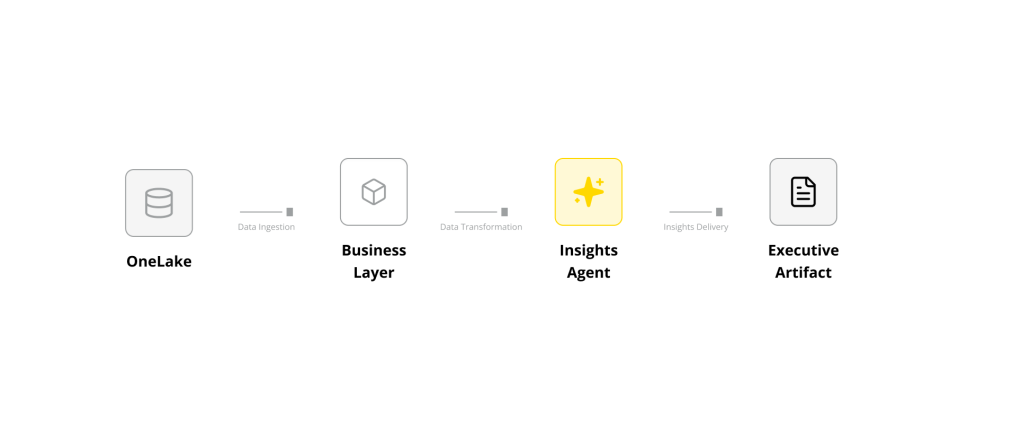
- Data foundation in Fabric: Data lives in OneLake and Fabric-connected sources, shaped through Lakehouse/Warehouse patterns.
- Business layer for definitions: Anchor decision-grade analysis on Power BI semantic models where your org encodes business meaning. This reduces debates and makes outputs repeatable.
- Insights agent layer (Zebra AI Workload): The agent's job isn't summarizing datasets. It's producing a stable executive narrative: headline, drivers, drill-down, implications, in a visual language that leadership reads quickly.
How Zebra AI enhances Fabric in practice
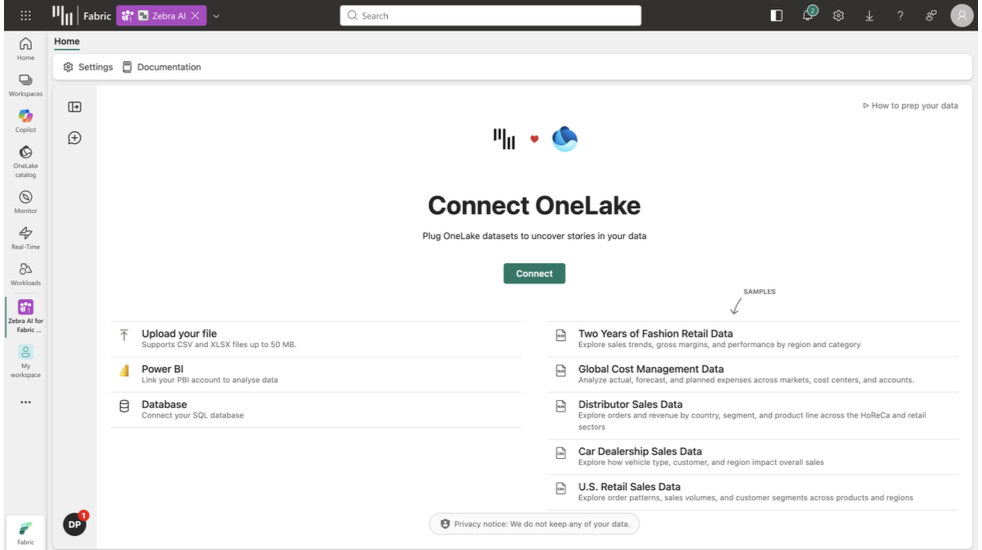
Zebra AI connects to the sources teams already use: OneLake, Power BI assets, SQL databases, and Excel/CSV for quick intake.
From there, it focuses on the Last Mile: turning Fabric-connected data into executive-ready visuals and automated data stories that leaders can interrogate themselves.
- Variance-first outputs: In leadership settings, no one asks for longer paragraphs. They ask: "Show me the drivers. Where exactly did this happen? How does it roll up?" Text alone is fragile. Visual driver logic is resilient. Zebra AI is built on IBCS-style visuals that compress complex information into formats executives can read in seconds.
- Follow-up depth without analyst tickets: The "why spiral" is where analyst time disappears: new cuts, new slices, new screenshots, new decks. Zebra AI lets business leaders ask follow-ups themselves while keeping the narrative anchored in one coherent story frame.
- Shareable artifacts inside Fabric: Insight doesn't scale if it lives in one person's session. Zebra AI enables collaboration so stakeholders review the same story asynchronously and arrive at meetings aligned on one narrative, not five conflicting screenshots.
- Office-ready packaging: Boardroom communication still ends in PowerPoint and Excel. Zebra AI exports directly to both, eliminating manual deck-stitching and making the path from Fabric insight to executive presentation seamless.
What 'governed' means in practice
AI analytics fails quietly when the system guesses at column meanings, grain, baselines, or time interpretation.
Zebra AI addresses this with practical guardrails:
- Column-level context to attach business meaning where ambiguity lives
- Fiscal year awareness so comparisons align with finance reality
- Standardized output shape (headline, drivers, summary, implications) so stakeholders learn to read results without relitigating the format
- Permission-aware consumption that respects existing RLS boundaries
The goal isn't impressive prose. It's repeatable decision-making.
The ROI case
Fabric investments pay off when the business can do three things faster:
- Reduce cycle time from KPI movement to defensible explanation
- Reduce analyst churn from repeated stakeholder requests
- Increase adoption of governed data by making it decision-ready
A governed insights agent multiplies all three: it standardizes narrative, keeps the story coherent under scrutiny, and makes distribution effortless.
A large Swiss insurance company transformed quarter-close reporting with Zebra AI on Microsoft Fabric. What used to take controllers a week per person, aggregating Excel data, identifying drivers, and writing commentary, now happens in a few hours. One leader rebuilt the entire executive story from ~200,000 rows of data: variances surfaced, drivers identified, governed narrative generated, all in a structure that holds up under executive scrutiny.
The result: one standardized story that refreshes quarterly, eliminates the "why spiral," and lets the team focus on decisions, not decks. "This is exactly what our controllers do. Zebra AI does it in seconds."
- Use Fabric as the foundation: OneLake plus shaped analytics assets
- Anchor business meaning in semantic models, hierarchies, and fiscal logic
- Make interpretation explicit with column-level context
- Standardize executive outputs with variance-first visuals and a consistent narrative structure
- Make it distributable via shareable links and reusable artifacts
The takeaway
Microsoft Fabric is the right foundation for the first 99 miles: unifying data in OneLake, shaping it into analytics-ready assets, and governing it through shared models and workspaces.
Zebra AI is the decision layer that makes that foundation payoff: turning governed data into automated decision stories with executive-ready variance visuals, deep self-serve Q&A, shareable artifacts, and Office-ready outputs.
Fabric makes it possible. Zebra AI makes it decisive.
Stop by Booth 742 and see how Zebra BI turns Fabric into clear, confident decisions.
