September 8th
 February 22nd

20 years in the making: IBCS is now an ISO Standard
Something happened recently that I have been waiting for since I built my first business report 2 decades ago. The International Business Communication Standards (IBCS) have been ratified as ISO 24896, the new official ISO standard for business reporting notation. For those of us who have spent years trying to convince finance teams that a bar chart should not look like a fireworks display, this is not a small moment. It is a turning point.
Let me tell you how we got here.
The problem that started everything
Think of any financial review meeting you have ever sat in. Someone opens a PowerPoint. The first slide has a red-themed dashboard with a 3D pie chart.
The second has a blue-themed table. The third uses green to mean "approved budget" while the fourth uses green to mean "positive variance." Nothing connects. Everything has to be explained from scratch.
This was the norm in 2004 when Dr. Rolf Hichert, a German management consultant and professor, decided the business world needed a common language for data.

From that single principle, Hichert spent years building a complete notation system for business reporting: rules for how to organize content, how to choose the right chart type, and how to unify terminology, dimensions, and scenario indicators across an entire organization. He called it IBCS: the International Business Communication Standards.
Things that mean the same thing have to look the same. And if things do not mean the same thing, they should not look the same.
Standing on the shoulders of giants
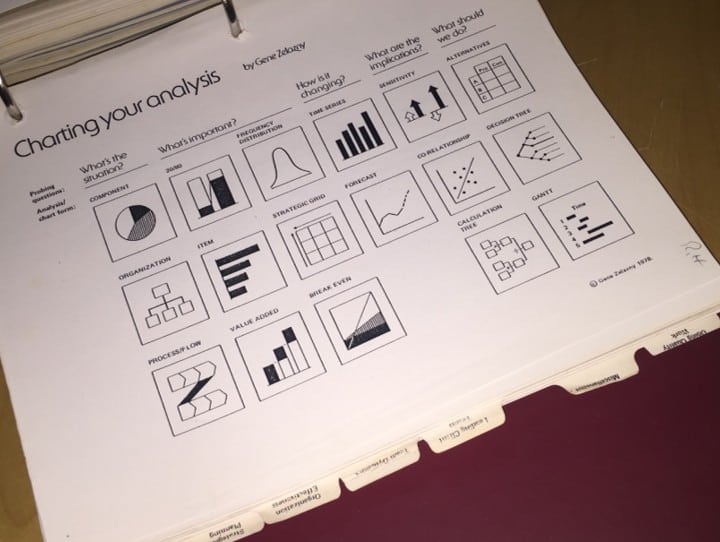
Hichert did not invent the desire for structured data communication. That conversation had been running for decades. In 1978, McKinsey consultant Gene Zelazny published a deceptively simple framework called "Charting Your Analysis," a chart selector that mapped five fundamental business questions to the right visualization type. It was one of the earliest attempts to bring systematic thinking to how analysts present data.
Edward Tufte had written about the data-ink ratio and the elimination of chartjunk. William Playfair had invented the bar chart itself. Barbara Minto had given us the Pyramid Principle for structuring arguments. But none of this had been synthesized into a coherent, portable standard that an organization could adopt wholesale and apply consistently across every report, every team, every country.
That is what Hichert set out to do. IBCS synthesizes this intellectual lineage into a repeatable notation system: a full vocabulary for business communication, not just a style guide.
What IBCS rules look like in practice
The 3 pillars of IBCS are conceptual, perceptual, and semantic rules.
Conceptually, IBCS prescribes how to structure information so the message is clear before you look at a single number.
Perceptually, it tells you which chart to use and why: time series go on horizontal axes, structural comparisons on vertical ones, a rule that applies to roughly 95% of business charts.
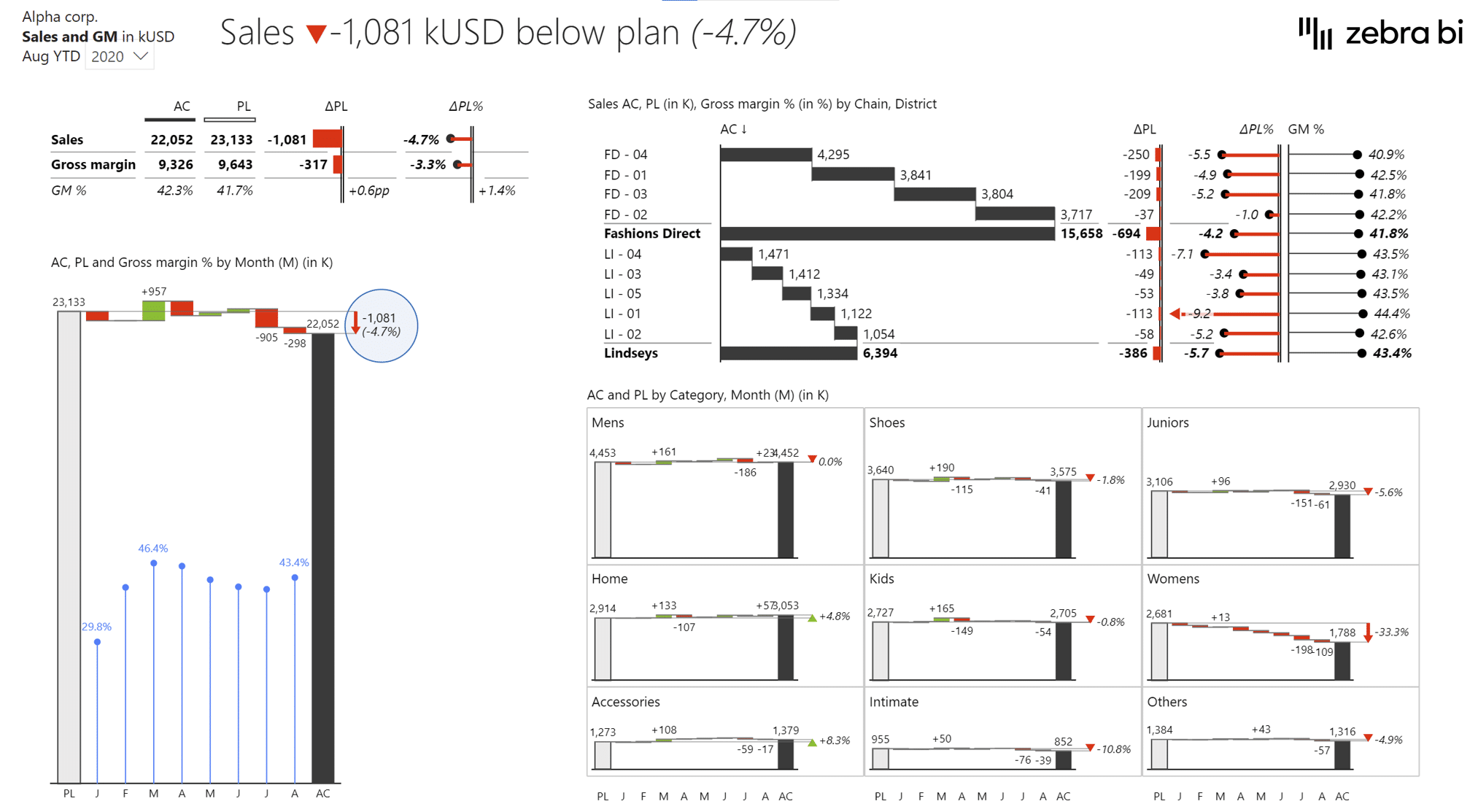
Semantically, it creates a shared notation: solid fills for actuals, outlines for plan, hatched patterns for forecasts. Green signals a positive variance; red signals a negative one. The "+" sign on positive variance values is not decoration. It is a semantic marker that distinguishes a variance from an absolute value at a glance.
Follow these rules consistently and something remarkable happens. A new analyst joining your team can read a report from any department without a briefing. An executive can compare this quarter's results to last year's without asking which color means which scenario. Reports stop requiring a legend and start communicating on their own.
How I found Rolf Hichert, and why I built Zebra BI around his work
In 2006, I heard about a management reporting course conducted by Professor Dr. Rolf Hichert in Zurich. I had no connection to him, no referral from a colleague. I just took two days of personal leave, paid for the course myself, and got on a plane to Switzerland.
That course changed how I thought about reporting entirely.
IBCS gave me something I had not found anywhere else: not a set of aesthetic preferences, but a reasoned, consistent system backed by decades of research in perception and communication. I built Zebra BI around it. Not as a feature checkbox, but as the foundation for everything we do.
The standard should be invisible to the user. But always present in the output.
Rolf remembered that first meeting in his own way. Years later, reflecting on it, he said:
I thought, this is a smart kid from Slovenia. But I didn't think that he might change the world, or that we could change the world together.
In 2012, I showed an early version of the software at a conference in Germany. Rolf was there. He encouraged me to keep building. That backing mattered more than I let on at the time.

By 2015, Zebra BI's original product for Excel had earned IBCS certification. When we built Zebra BI for Power BI, we went through the certification process again, and in 2020 our Power BI visuals became IBCS-certified too.
The work of translating abstract notation rules into software that anyone could use without memorising the standard had been, in many ways, a decade-long dialogue with the ideas Hichert seeded back in 2004.
I also had the opportunity to contribute directly to the standards work as IBCS moved toward ISO ratification.
Watching that process from the inside made this announcement land differently than it might for someone encountering IBCS for the first time. This did not happen by accident. It happened because an entire community of practitioners, standards bodies, and companies believed that data communication deserved the same rigor we apply to financial accounting or engineering tolerances.
We cannot change the world, it's people like you. You offer the solution. We can only open people's minds and lead them in the right direction. But without people like you helping them to go this way, we have no chance.
From a consultant's vision to ISO 24896
The path from Hichert's initial framework to an international standard was not a straight line. The IBCS Association grew to more than 12,000 members across 139 countries. Enterprise adopters including Philips and SAP validated the standard at scale. The DACH markets in Europe became early strongholds; adoption then spread to multinationals with global reporting requirements.
The formal ISO process brought experts from 12 countries into the drafting work. The resulting standard, ISO 24896, codifies the notation system that Hichert and his collaborators developed over two decades.
It now sits alongside other ISO standards that govern how professionals in their fields communicate. Accounting has its standards. Engineering has its standards. Business reporting now has one too.
What ISO 24896 means for finance and analytics teams
An ISO standard does something that no amount of consulting or blog posts can do: it creates an institutional mandate. When IBCS was a best practice, it was easy to deprioritize in favour of whatever the executive team was used to seeing. When IBCS is ISO 24896, it becomes the reference point for auditors, enterprise procurement, and regulatory frameworks.
For finance teams and BI professionals who have already adopted IBCS, this is validation of a choice they made years ago. For those who have not, it is a signal that the window for easy adoption is open now, before compliance becomes a retrofit problem across thousands of reports.
Where Zebra BI sits in this
Zebra BI has been IBCS-certified since 2015, with our Power BI visuals earning their own certification in 2020. Both certifications now directly map to ISO 24896.
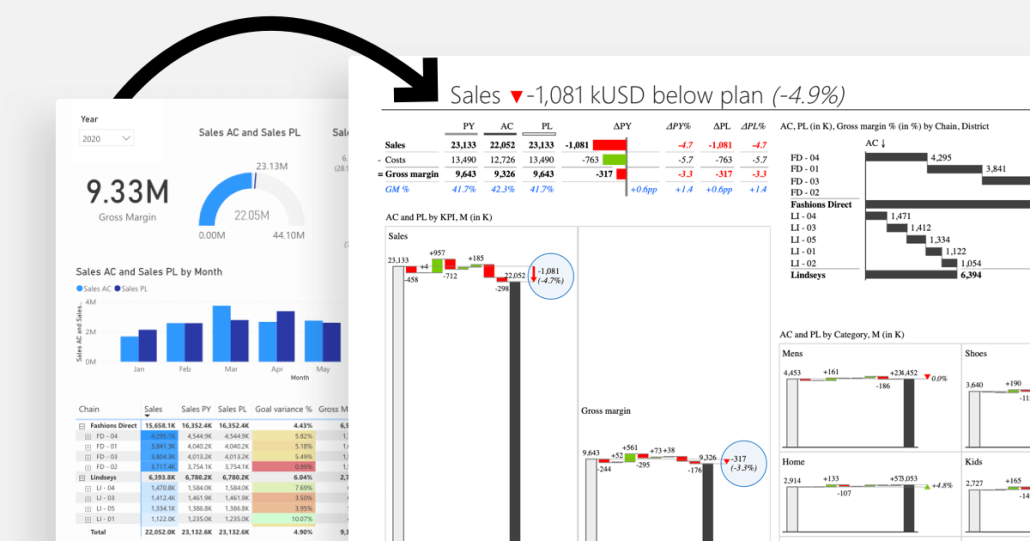
Every Zebra BI chart, table, and variance visual your team builds inside Power BI, Excel, and PowerPoint already conforms to what is now an international standard. No rule memorisation required.
That was always the point. The standard exists to serve communication. The software should make the standard invisible. When a Zebra BI user drops a waterfall chart onto a report, the fill patterns, color conventions, and axis orientations are already correct. The analyst focuses on the insight. The notation takes care of itself.
We are now 1.5 million daily users across more than 3,000 companies in 115 countries. Many of those users do not know what IBCS is. They just know their reports look better,communicate faster, and require fewer explanations in meetings.
The time to adopt ISO 24896-compliant reporting
The ISO ratification is not the end of something. It is the beginning of a broader adoption cycle. Organizations that have built reporting conventions over decades will need time to align. Software vendors will need to catch up. Training programs will need to embed the standard into curricula.
Zebra BI has a 10-year head start on that work. We intend to use it.
If you have not explored what IBCS-compliant reporting looks like in practice, this is a good moment to start. The standard is no longer a niche argument from European management consultants. It is the answer to the question every data leader faces eventually: how do we make our reports actually mean something?
See what ISO 24896-compliant reporting looks like in Zebra BI:
- Start a free Zebra BI trial (full Enterprise features, no credit card)
- Book a 15-minute demo with our team if you want to see a finance report built live
Explore the Zebra BI community

Patrick Soehlke

Meena Laird

Rachel Guthrie
Wilco Nagtzaam

Kimberley Canoute

Raúl Vinuesa Arjona

Esteban Fabiani

Brahim Chabane
Ryan Cheung
Cheng Wang

Brian Julius

Jonathan Kapoor

Lars Schreiber

Pascal Kiefer

Harry Ferrera

Jeff "Power BI Lobbyist" Weir
Manuel Barahona Gandía

Daniel DeHaven

Tania Tombak